Technology
Phase change. Compact. Bankable.
A short tour of the science, the engineering and the data behind the Thermal Box.
The principle
When a phase-change material melts, it absorbs a large amount of energy at almost constant temperature. When it solidifies again, it releases the same energy back into your system. We exploit that latent heat to store kWh in a fraction of the volume of a water tank.
- −20 → 120 °CPCM operating range
- ≥ 25 yrsdesign life
- 5×vs. water tank
- Non-flammablelow maintenance
How it works
Norwegian engineering, packaged as a thermal battery in a box.
Phase change materials store heat or cold when they melt and freeze. We package that physics into a compact, modular battery — and the controls that make it pay back.
Charge
When energy is cheap, clean or surplus, the Thermal Box absorbs heat or cold using phase change materials.
Store
PCMs change phase at exactly the temperature you need — banking 5× more energy per litre than water, with minimal losses.
Discharge
When demand peaks, the smart pump skid releases energy back into your existing HVAC, process, or grid.
Optimise
The controller cycles automatically against spot prices and CO₂ signals — every hour, all year round.
Patented · Made in Norway
A decade of phase change engineering, productised in Trondheim and shipped to projects across Europe.
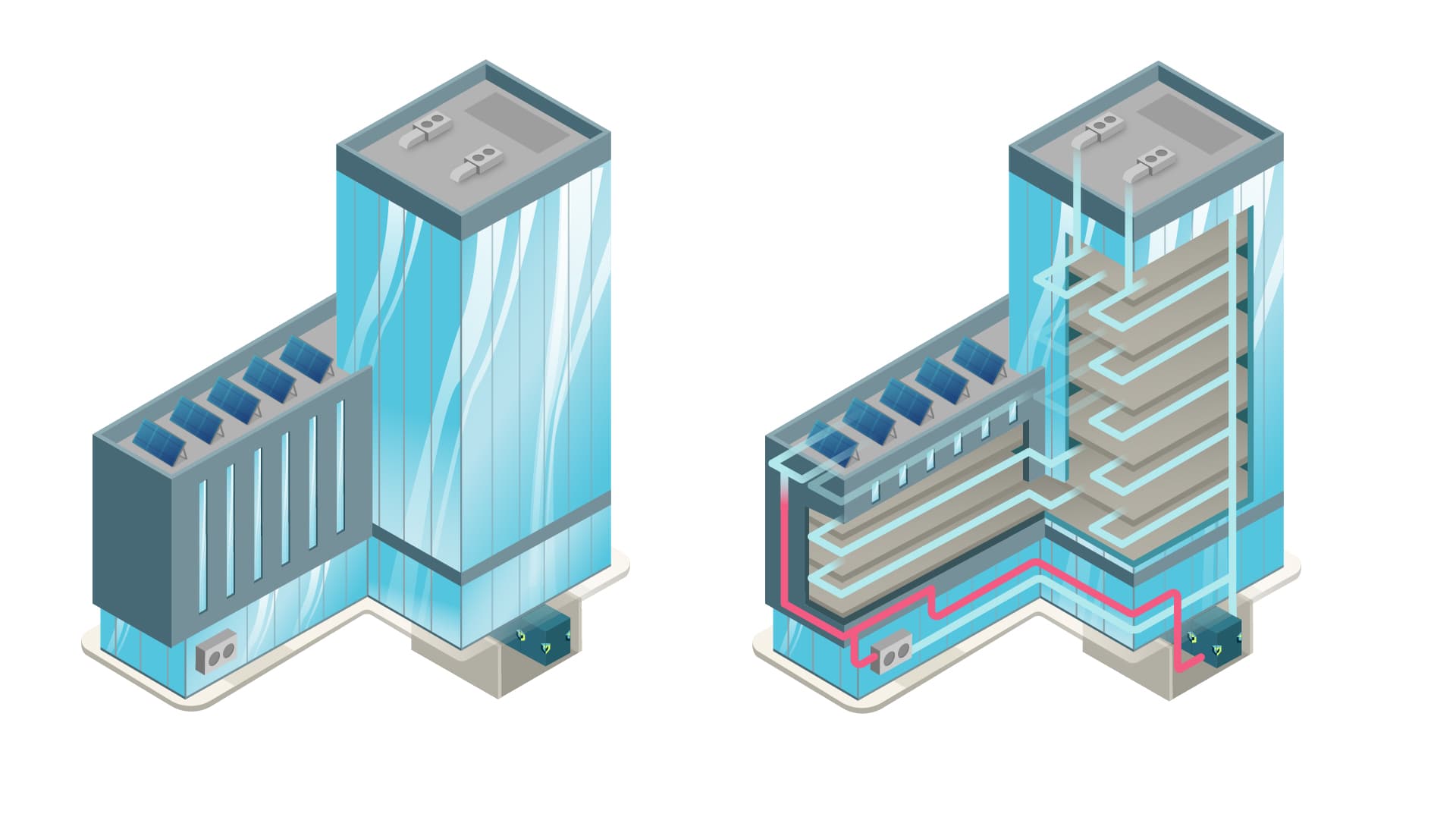
From Norway to your basement
The Thermal Box is designed, engineered and produced in Norway. It builds on more than a decade of phase-change research — much of it carried out by our founders alongside the SINTEF and NTNU communities in Trondheim — and we still publish open research with them today.
We work hard to be a fair and transparent supplier — no proprietary refrigerants, no vendor-lock data, and an open API that lets your aggregator do its job.
Common questions
Got questions about thermal storage?
From PCM chemistry and lifetime to indoor vs outdoor installs and typical payback — the answers are in the full FAQ.
Read all questionsWhat is thermal energy storage?
The term is used when storing energy as heat or cold, which can be released at a later stage. The heat or cold is usually stored when energy is cheap and then released when the heating or cooling demand is at a peak or the cost of energy is high.
What is PCM?
PCM means Phase Change Material and refers to any material that changes state, for example from solid to liquid, when reaching a certain temperature. This phase change enables large amounts of energy to be absorbed or released. Water is one PCM, storing cold at zero degrees Celsius by changing phase to ice. Cartesian uses a wide variety of other materials, such as bio-based waxes, to store heat or cold at different temperatures.
Is the Thermal Box and the PCM flammable?
For applications with HVAC systems, Cartesian's Thermal Box is not considered flammable. While some PCM might be flammable when they reach temperatures above 100 °C or more, the Thermal Box is designed to eliminate any risks of reaching flammability conditions in operations.
Are PCMs safe?
Cartesian offers only safe PCMs and primarily uses bio-based PCMs in the Thermal Box. The PCM will stay in the Thermal Box for its whole lifetime and is not consumed during operation. The Thermal Box is also designed to avoid any risk of PCM leakage.
Let's build the smarter grid